Damp proofing and timber treatment in Barnsley
We are a family firm in Rotherham, a short drive from Barnsley, working in and around the town on damp, rot, woodworm, cellars, wall ties and cavity insulation. We find the cause before we quote, and tell you if the fix is not one for us.
- Family-run
- Over 30 years in the trade

Local knowledge
Barnsley homes and the damp they get
Barnsley grew with the coal industry, and the town and the former pit villages around it, such as Cudworth, Royston, Wombwell and Hoyland, have a great many brick terraces from the late 1800s and early 1900s, alongside interwar and post-war council housing and newer estates. Each kind of house gets damp in its own way.
- Pit-era terraces
- Solid brick walls with no cavity, so rain soaking into worn pointing or cracked render can reach the inside, and a damp proof course more than a hundred years old, if there is one at all, can let moisture rise from below. See penetrating damp and rising damp.
- Suspended timber floors
- Joists a short way above the ground, kept dry by air bricks in the front and back walls. Where yards and paths have been raised over the years, those air bricks can end up blocked and the joists can rot. See wet and dry rot.
- Interwar and post-war estates
- Here damp is more often condensation or a leak than rising damp, and cavity walls can bring problems of their own, such as rusting wall ties.
Our services
What we do in Barnsley
Every service we offer, in and around Barnsley. Each links to the full page on how the work is done.
Damp
- Damp proofingFinding where the damp in your home really comes from, the ground, the rain, the air inside or a leak, and fixing that rather than the symptom.
- Rising dampA new damp proof course injected into a solid brick wall where the old one has failed, after clearing anything bridging it, such as a raised yard.
- Penetrating dampTracing where rain gets into a solid terrace wall, through pointing, render, gutters or downpipes, and putting the outside right first.
- Condensation and mouldBlack mould and streaming windows, often on the newer estates, dealt with by better ventilation and steadier heat, not damp proofing.
- Damp surveysA look at the whole house when you are buying, selling or letting, or when damp has come back after treatment.
Timber
- Timber treatmentFloors, joists and roof timbers in older houses treated for woodworm and rot, with the damp behind them fixed too.
- WoodwormWoodworm in floorboards, stairs or roof timbers checked for activity before anything is treated, as many old holes need nothing at all.
- Wet and dry rotRotten skirting boards, joist ends, door frames and window boards cut out and replaced with treated timber, once the damp behind them is fixed.
Basements and cellars
Wall ties and cavity walls
- Wall tie replacementNew ties where the old ones holding the two layers of a cavity wall have rusted, checked first, as cracked brickwork has more than one cause.
- Cavity wall insulation removalInsulation that has got wet and is letting damp across to the inside taken out, once we have checked it really is the cause.
In more detail
Our work in Barnsley, in more detail
What each kind of job involves in Barnsley homes. Open any you want to read.
Choosing a damp proofer in Barnsley
Most damp in a house comes from one of a few places: the ground, the rain, the air inside, or a leak. A damp proofer worth calling works out which before recommending anything, because each needs a different fix.
In a Barnsley terrace that means checking the ground levels and air bricks outside, the pointing, gutters and downpipes, how the house is heated and aired, and the floor timbers underneath.
You should get a clear explanation in plain words, a quote that says what it covers, and honest advice on anything you can put right yourself. See how we approach damp proofing.
Damp treatment in Barnsley: three causes, three treatments
If moisture is rising from the ground past a failed damp proof course, the treatment is a new damp course and fresh plaster: see rising damp treatment.
If rain is getting in through worn pointing, cracked render or a leaking gutter, the treatment is outside, and then the wall is left to dry. The solid brick walls of Barnsley's terraces are especially open to it. See penetrating damp.
If the damp is condensation, the treatment is ventilation and steady heat, not damp proofing at all.
Damp injection in a Barnsley terrace
A typical Barnsley terrace has solid brick walls and, if it has a damp proof course at all, one that is more than a hundred years old. Where moisture from the ground is rising past it, a water-repellent cream injected along a mortar course near the bottom of the wall forms a new one.
Before injecting, anything bridging the old damp course has to go: a raised yard, a path, or render that runs down over it. Sometimes that alone solves the problem.
Afterwards the salt-damaged plaster is replaced, as salts left in the wall keep drawing in moisture. More on rising damp treatment.
Timber treatment for Barnsley floors and roofs
The suspended timber floors in Barnsley's older terraces rest on joists a short way above the ground, kept dry by air flowing in through air bricks. When those air bricks are blocked, or the walls are damp, the joists and boards stay wet.
Wet timber is where rot starts, and woodworm does best in it too. Roof timbers suffer the same way under a leaking roof or a blocked gutter.
Treatment means fixing the damp, treating the sound timber with a preservative and replacing what has lost its strength with treated timber. See how timber is treated.
Where wall rot starts in Barnsley homes
In a solid-walled terrace, timber touches the walls everywhere: skirting boards, the ends of floor joists, door frames and window boards. If the wall is damp, from rising damp, rain getting in or a leaking gutter, that timber stays wet and rots.
Often the first sign is a skirting board that has gone soft, or plaster above it that crumbles. Behind it, the joist ends may have rotted too.
The damp is fixed first. Then rotten timber is cut out and replaced with treated timber, and the timber around it is treated. Dry rot, which can spread across brickwork, is treated over a wider area. See wet and dry rot.
Woodworm treatment in Barnsley homes
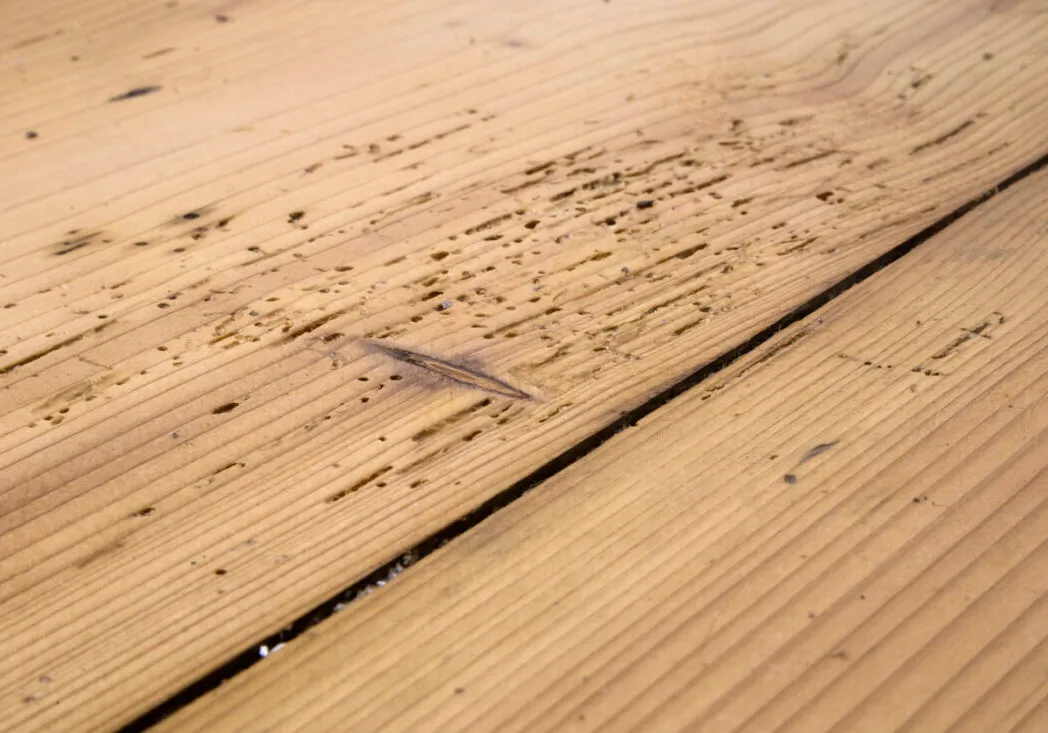
The common furniture beetle attacks softwood: floorboards, joists, stairs and roof timbers, all of which Barnsley's older houses are full of. It does best where the timber is damp, such as a floor that stays damp underneath (see timber treatment) or a roof that has leaked.
Fresh, pale dust below the holes and clean-edged holes mean it may still be active. Dark holes with no new dust usually mean it died out long ago.
Where it is active, the affected timber and the timber around it are treated so beetles die as they come out and new larvae cannot get in. See how woodworm is treated.
Reviews
In our customers’ words
More reviews, or read every one on Google (opens in a new tab) and Trustpilot (opens in a new tab)
Talk to us about your home in Barnsley
Every job is priced on what we find, so the quote is free and sets out exactly what it covers.
- Based in Rotherham, working across South Yorkshire and nearby
- Most jobs take one to five days
Questions
Questions about damp and timber in Barnsley
Not covered here? Ask us. A photo of what you have noticed helps.
What does the work cost?
It depends what is causing the problem and how much of the house is affected, so we price each job on what we find. The quote is free.
Should I get more than one quote?
It is sensible, especially for a bigger job. Compare what each says is causing the damp, not just the price: two quotes that disagree on the cause cannot both be right.
Is a damp proofer the same as a damp surveyor?
Often the same person. A damp surveyor finds the cause; a damp proofer carries out the treatment. We look at the problem first, then quote for any work. See damp surveys.
Why are the walls of my terrace damp after rain?
Solid brick walls have no cavity, so heavy rain soaking into worn pointing or cracked render can reach the inside. Fixing the pointing, gutters and downpipes usually comes before anything inside. See penetrating damp.
My yard has been concreted up to the back wall. Is that a problem?
It can be. Concrete laid above the damp proof course lets moisture past it, and can cover air bricks too. Cutting it back to at least 150mm below the damp course, and clearing the air bricks, is often the first fix.
Can I just paint over damp?
Not until the cause is fixed. Paint on a damp wall bubbles and peels, and mould comes back through it.
How high does rising damp go?
It seldom climbs much above a metre. Damp higher up the wall usually has another cause, such as rain getting in or condensation.
Is damp injection messy?
Holes are drilled along a mortar course and the damaged plaster comes off, so there is some dust and the room needs clearing. The holes are filled afterwards.
Will the wall need re-plastering?
Usually, yes, after rising damp. Plaster that has held it is full of salts, which keep drawing moisture from the air and show through new paint.
Why does my floor feel springy?
A springy or dipping floor can mean the joists underneath have rotted or been weakened by woodworm, often where they rest on a damp wall. It is worth having checked before it gets worse.
Do air bricks really matter?
Yes. They let air flow under a timber floor and keep the joists dry. Keep them clear of soil, paving and plant pots.
Can old timber be saved?
Often. Sound timber can be treated and kept; only timber that has lost its strength needs replacing.
Is wall rot dangerous?
Rot in skirting is mostly a nuisance, but rot in joist ends or lintels weakens timber that holds up the floor or the wall above, so it is worth checking how far it has gone.
Why has my door frame rotted at the bottom?
Usually because the wall or floor next to it is damp, or water collects at the threshold. The frame can be repaired once the damp is dealt with.
Is dry rot treated differently?
Yes. Dry rot can spread to timber some way from where it started, so it is treated over a wider area and needs dealing with promptly.
How can I tell if woodworm is still active?
Fresh, pale dust below the holes and clean-edged holes mean it may still be active. Dark holes with no new dust usually mean it died out long ago.
When is woodworm most noticeable?
In late spring and summer, when adult beetles come out, leaving new holes and fresh dust. Dead beetles on windowsills at that time of year are worth noticing.
Will woodworm hold up a house sale?
A buyer's survey will look for it, and active woodworm can hold up a sale until it is treated. Old holes with no sign of activity usually need no more than a check.
Is there anything I can do myself?
Often. Clearing gutters, lowering soil against a wall, keeping air bricks clear and letting moist air out of kitchens and bathrooms all help. We tell you what you can do yourself when we look.
Do you cover Barnsley?
Yes, in and around Barnsley. Tell us where you are when you get in touch.
Not sure what you are looking at? Send us a photo.
A picture of the wall, floor or timber helps us understand the problem.
or call 07579 009 735, or see all the ways to reach us